
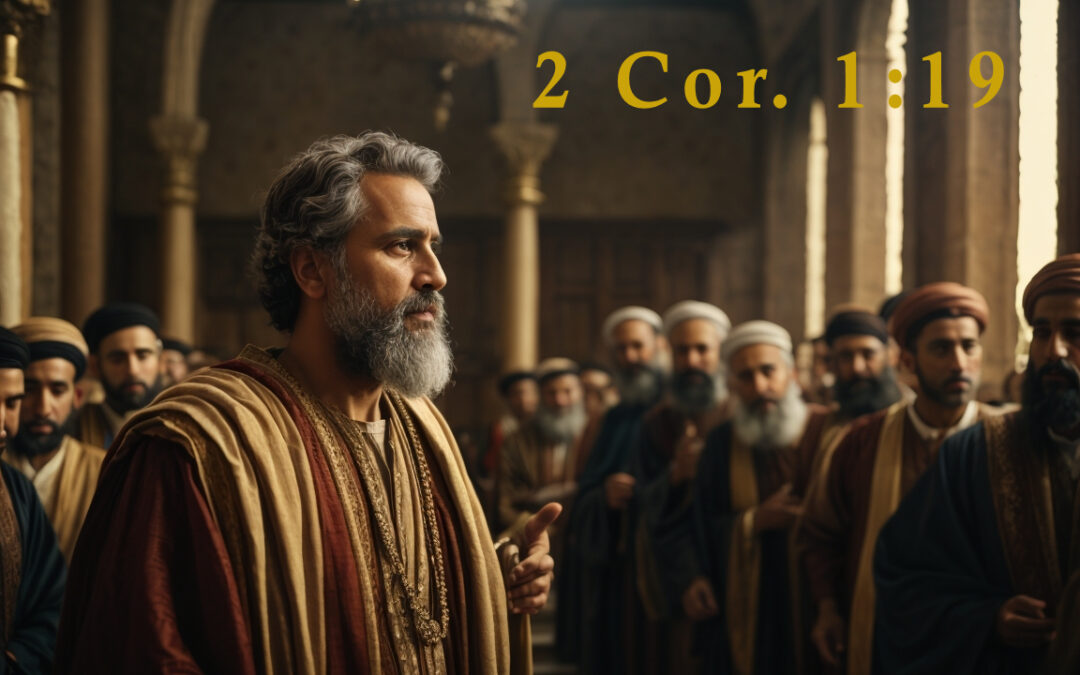
“For the Son of God, Jesus Christ, who was preached among you by us, even by me and Silvanus and Timotheus, was not yea and nay, but in him was yea.”
(2 Corinthians 1:19)
In his second epistle to the Corinthian church, Paul reminds his readers that the message he and his fellow laborers proclaimed was one and the same. Their preaching was consistent, because their subject was consistent: Jesus Christ, the Son of God. And He, Paul insists, “was not yea and nay, but in him was yea.” That is, Christ is not variable or uncertain. His promises are not wavering or unclear. His person and message are as unchanging as His divine nature.
Paul identifies both the divine and human natures of Christ in this verse. He is the “Son of God,” eternally begotten and co-equal with the Father… and He is “Jesus Christ,” the name given to the incarnate Son, born of a woman to redeem those under the law. The divine and human are united in one Person, without confusion and without division. He is the Mediator, the Messiah, the appointed Redeemer of the elect.
The good news of salvation in Christ—His substitutionary death, His victorious resurrection, and His eternal priesthood—is the sum and focus of all Christian preaching. Paul’s entire ministry was bound to the proclamation of “Christ crucified” (1 Cor. 1:23). And the apostles, as well as all faithful ministers since, have preached the same gospel which is rooted in eternal decree and fulfilled in history.
This Jesus, the promised Messiah, is He of whom the prophets spoke and to whom the Scriptures testify. As 1 John 5:1 declares, “Whosoever believeth that Jesus is the Christ is born of God.” One’s confession of Jesus as the Son of God is the evidence of God’s indwelling grace in their life. And it is this confession that stands in contrast to the world’s confusion, just as it did in Paul’s day when the Jews, hoping for a political deliverer, rejected the suffering Savior.
But Christ’s first coming was not to claim David’s throne in Jerusalem, but to reign in the hearts of His people and lay down His life as the ransom for many. Now exalted to the right hand of God, crowned with glory and honor, He continues to build His Church and rule over all things for her sake.
For this reason, let every faithful preacher heed the exhortation of Burgess: “That Christ only is to be the subject of all our preaching.” For He alone is unchanging, He alone is sufficient, and He alone is worthy.[1]
Contemplation:
- A Constant Christ in a Changing World. While reflecting on 2 Corinthians 1:19, “For the Son of God, Jesus Christ, who was preached among you by us, was not yea and nay, but in him was yea,” I am reminded of the unwavering nature of Christ. In a world filled with inconsistencies and uncertainties, Christ remains my steadfast anchor.
- The Messiah’s Promise. When I think about the body of prophetic promises and their fulfillment in Jesus of Nazareth, I’m always amazed at how He perfectly embodies the prophecies. As Psalm 2:6 states, “Yet have I set my king upon my holy hill of Zion,” emphasizing the divine plan that was fulfilled in Christ.
- The Unity in Christ’s Natures. Even though Christ was both divine (God the Son) and human (Jesus), I find comfort in the assuring truth that He is the Living Word (John 1). What this means is that His mission, His teachings, and His promises are all consistent with God’s written word.
- Spiritual Fulfillment in Christ. The Jews were looking for a “savior” who would rescue them from Roman rule. But God’s plan for Messiah’s coming was found in the eternal spiritual transformation it would accomplish within the hearts of believers.
Prayer (Supplication):
O Lord, my God, I come before You in humility, asking for grace to trust more deeply in the unchanging promises of Christ. Your Word declares that in Him there is no contradiction, no wavering, no double-mindedness. In Him is only “yea”—certainty, assurance, and truth. Yet I confess how quickly my heart forgets and fears, how easily I doubt and drift.
Help me, Lord, to rest more fully in the unshakeable foundation of Christ. In a world filled with shifting voices and uncertain paths, anchor me in the constancy of Your Son. Let me not be tossed about by changing feelings or philosophies, but let me stand firm in the certainty that all Your promises are “yea and amen” in Him.
Lord Jesus, Your Gospel was preached by Paul and Silvanus and Timotheus, and by countless faithful ministers through the ages. I ask You to bless those who continue to lift up Your name. Strengthen Your servants who proclaim the gospel, and let them never turn aside to lesser things. Let the message of Christ remain the center of every pulpit and the pulse of every true church. Raise up men who love Your truth more than popularity, and who will preach Christ crucified with boldness and clarity.
I ask also for Your help in my own witness. Make me a faithful proclaimer of this same gospel—not only in words but in conduct and in devotion. Let my life speak of the unchanging love and power of Christ and let me not remain silent when others need to hear. Give me wisdom and boldness to declare that Jesus is the Christ, the Son of the living God.
When I am weary, remind me of the power that raised Him from the grave. When I feel uncertain, remind me that He is the same yesterday, today, and forever. When I sin, remind me that He is faithful and just to forgive. When I walk through suffering, remind me that He walks with me and holds me fast.
O Lord, make me faithful to hold fast to the gospel and let it not grow dull to me. Let the timeless, unchanging truth of Christ be ever new to my soul. Guard me from apathy. Protect me from compromise. Give me a heart that delights in the truth and hands that are ready to serve in the name of the One who never changes.
I ask all this because I need Your help, and because You are the God who helps those who call upon You. Strengthen me by Your Spirit, ground me in Your truth, and let my life reflect the unwavering glory of Christ.
In Jesus’ name I pray, Amen.
Further Scripture References for 2 Corinthians 1:19:
Heb. 13:8; Matt. 4:3; 2 Thess. 1:1; Mark 1:1.
[1] Anthony Burgess, An Expository Comment, Doctrinal, Controversial, and Practical upon the Whole First Chapter to the Second Epistle of St. Paul to the Corinthians (London: A.M. for Abel Roper .., 1661), 556–558.
