
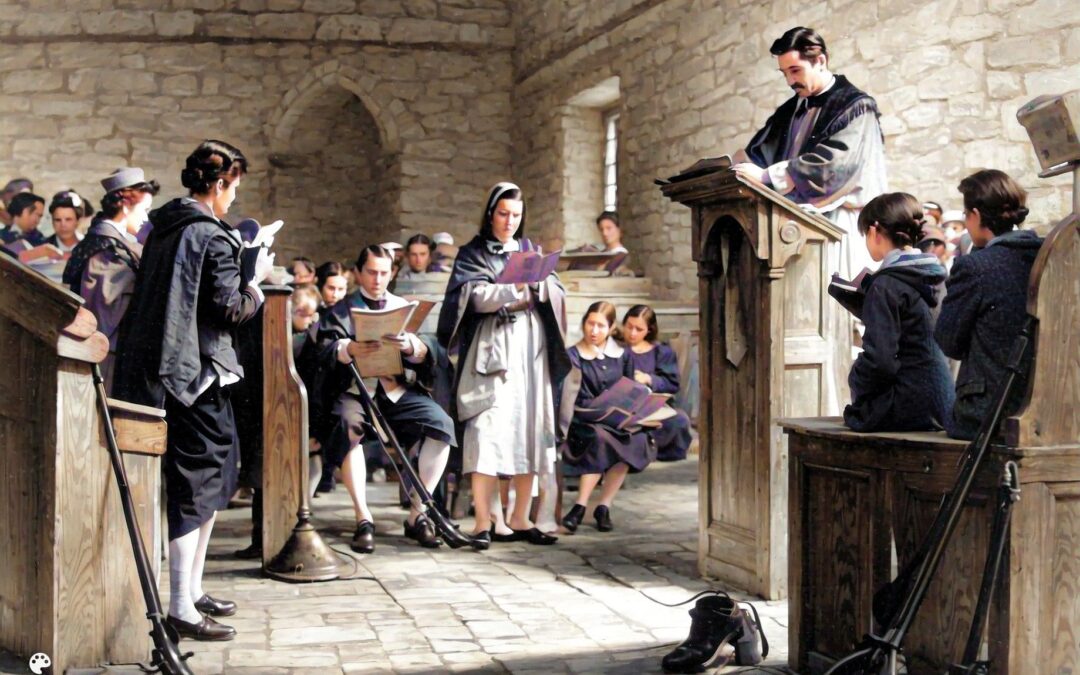
“For in six days the LORD made heaven and earth, the sea, and all that in them is, and rested the seventh day: wherefore the LORD blessed the sabbath day and hallowed it.” (Exodus 20:11)
The Sabbath of the Lord is a day of holy rest, a full day God set apart at creation to be sacred, devoted to spiritual restoration, and filled with prayerful worship of Him. From the beginning of the world until the resurrection of Christ, the Sabbath was observed on the last day of the week. After His resurrection, the day was changed to the first day of the week, for Christ rose from the dead on that day. Scripture refers to this as the Lord’s Day, and the church has rightly recognized it as the Christian Sabbath.
This day is unlike the other six days, for it has been consecrated by God’s moral law. Exodus 20:10 declares, “It is the Sabbath of the Lord thy God.” The Sabbath rest of the seventh day, in both the Old and New Testaments, was divinely instituted (Acts 1:3, 20; 1 Cor. 16:2; Rev. 1:10), and stands as one of the Ten Commandments. If the Sabbath were not binding, then there would be only nine commandments. But the Lord’s command remains, for He Himself sanctified this day and set it apart for holy use.
When God blessed and sanctified the Sabbath, He bestowed honor on that day above the rest of the week. Only He has the authority to ordain and consecrate something to a holy purpose, and the Sabbath carries His divine mark. This consecration is not without blessing for His people, for the Lord promises spiritual benefits to those who delight in this day. In Isaiah 58:13-14, God says, “If thou turn away thy foot from the sabbath, from doing thy pleasure on my holy day; and call the sabbath a delight, the holy of the LORD, honorable; and shalt honor him, not doing thine own ways, nor finding thine own pleasure, nor speaking thine own words: Then shalt thou delight thyself in the LORD; and I will cause thee to ride upon the high places of the earth, and feed thee with the heritage of Jacob thy father: for the mouth of the LORD hath spoken it.”
The keeping of the Sabbath, then, is not just a matter of refraining from labor; it is the purposeful turning of the heart and mind toward God. It is to be a day given to worship, thanksgiving, meditation on His works and Word, and fellowship with His people. Worldly business, daily cares, and secular entertainments are set aside on that day so that the soul may be refreshed in the presence of God.
William Gouge wisely observed, “This rest in which the Sabbath consists of is not about being idle or doing nothing at all. But rather, in forbearing the ordinary works of the six days, the works of our worldly calling.”[1] Such rest is both an act of obedience and a source of blessing. It frees the believer from the demands of temporal labor and offers the sweet liberty to devote the entire day to God’s glory.
The Sabbath is also a testimony to the work of Christ. Hebrews 4 presents it as a type and foretaste of the eternal rest to come, where the redeemed shall forever cease from their labors. Hebrews 4:9 affirms, “There remaineth therefore a rest to the people of God.” The believer’s observance of the Lord’s Day is also a visible witness to the power of the resurrection and a rehearsal for the everlasting rest of heaven.
To keep the Sabbath holy is to confess that God is the Creator, the Redeemer, and the Sustainer. It is to honor His law, rejoice in His promises, and anticipate the eternal fellowship of His presence. In setting aside one day out of seven for Him, the Christian not only obeys the commandment but also embraces the blessing, knowing that the Lord has appointed this day for the good of His people and for the glory of His name.
Contemplations:
- Seeing the Pattern. I acknowledge that the Sabbath pattern God established from creation applies to me as much as it did to His people in all ages. Six days are given for labor, but the seventh is to be my delight in the Lord. I want my observance of this holy day to reflect both obedience to His command and joyful anticipation of eternal rest, where I will delight in Him without distraction or interruption forever.
- Sanctifying the Sanctified. When I sanctify what God has sanctified, I am affirming His authority and His holiness. It is not enough to know the Sabbath is holy; I must set it apart in my life with deliberate care. By keeping it free from worldly pursuits and filling it with acts of worship, meditation, and service, I grow in personal holiness and experience the sanctifying work of God more deeply.
- Regard for the Holy. The Lord’s Prayer teaches me to hallow His name. Observing the Sabbath rightly is one way I regard Him as holy. As 1 Thessalonians 5:23 says, “The God of peace sanctify you wholly,” I desire my whole self—body, mind, and spirit—to be set apart for Him. The keeping of this day is part of that sanctification, shaping my desires, habits, and priorities according to His will.
- The Eternal Rest Ahead. The Sabbath reminds me of the eternal rest that awaits the people of God. As I cease from my labors and turn to worship on the Lord’s Day, I taste a small portion of that coming glory. This weekly rhythm is a gift that lifts my eyes beyond the burdens of life and fixes them on the joy that will never end, where every day will be the Lord’s Day in perfection.
Prayer (Adoration):
O Lord of heaven and earth, I praise You as the Creator who made all things in six days and rested on the seventh. You are the One who spoke the worlds into being, whose power is unmatched, and whose wisdom is infinite. You sanctified the Sabbath and blessed it, setting it apart for Your glory and the good of Your people. In this command, I see not only Your authority but also Your loving provision for my soul.
I adore You as the Lord of time and eternity, who governs the seasons, orders the days, and holds the span of my life in Your sovereign hand. In commanding a holy rest, You have declared that my life is not my own, but Yours, and that my days are to be patterned after Your perfect work. Your law is holy, just, and good, and I delight in it because it flows from Your own holiness.
I worship You, O Christ, risen on the first day of the week, who has transformed the Sabbath into the Lord’s Day through the triumph of the resurrection. This day is Yours by right of creation and by right of redemption. You have conquered sin and death, and in doing so, You have given Your people a foretaste of the eternal rest that awaits them in glory.
I honor You, Holy Spirit, who fills the Lord’s Day with power and joy, enabling me to worship in spirit and in truth. You draw my heart away from the noise of the world and toward the beauty of the Lord, making the Sabbath a delight.
May my observance of this day be an offering of love and obedience to You. May it be free from distraction, rich in worship, and filled with gratitude for Your works. Let the rhythm of labor and rest that You have ordained shape my life into one of order, peace, and devotion. And may my keeping of this day bear witness to the world that You are my God, my Redeemer, and my eternal rest.
Blessed be Your name, O Lord, for the gift of the Sabbath, for the blessings it brings now, and for the glory it foreshadows in the age to come.
In Jesus’ name I pray, Amen.
Further Scripture References for Exodus 20:11:
Gen. 2:2-3, Exod. 31:17, Lev. 23:3, Deut. 5:13.
[1] William Gouge, A Learned and Very Useful Commentary on the Whole Epistle to the Hebrews (London: A.M., T.W., 1655), 413–414.
