
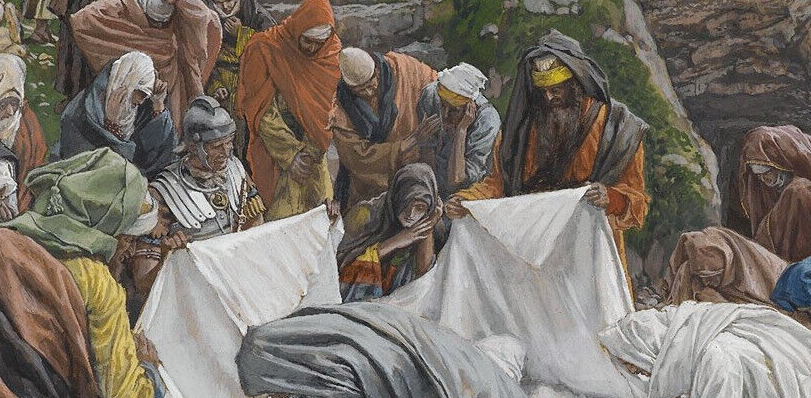
“And after this Joseph of Arimathea, being a disciple of Jesus, but secretly for fear of the Jews, besought Pilate that he might take away the body of Jesus: and Pilate gave him leave. He came therefore, and took the body of Jesus. And there also Nicodemus, which at the first came to Jesus by night, bringing a mixture of myrrh and aloes, about a hundred pound weight. Then they took the body of Jesus, and wound it in linen clothes with the spices, as the manner of the Jews is to bury.”
(John 19:38-40)
When one thinks of Joseph in the Scriptures, the mind typically turns first to the son of Jacob, whose life was a tapestry of divine providence, suffering, and eventual exaltation. Known for his coat of many colors, he served God faithfully in slavery, in prison, and eventually in the palace of Pharaoh. His faith stood firm regardless of the trials he endured.
The next Joseph most often remembered is the man espoused to Mary, the virgin mother of Christ. This Joseph was a quiet, godly man, entrusted with raising the Son of God and obedient to God’s direction, even fleeing to Egypt under angelic warning to protect the Christ-child from Herod’s wrath.
Yet there is a third Joseph, perhaps less commonly remembered, whose faith rose to prominence at the death of Christ—Joseph of Arimathea. Though he appears briefly in the Gospel record, his actions carry weighty significance. The Gospels agree in their testimony of this man’s role in Jesus’ burial (Matt. 27:57-61; Mark 15:42-47; Luke 23:50-54; John 19:38-42), and John tells us that he was a secret disciple of Jesus for fear of the Jews.
This Joseph was a respected member of the Sanhedrin, the Jewish ruling council, and had not consented to the decision to crucify Jesus. The cross moved him from concealment to courage. Once afraid to be associated with Christ, he now boldly approaches Pilate to request the body of Jesus. His faith, once silent, now speaks in action. It may be that witnessing the unjust suffering and unmatched dignity of Christ in death stirred in him a conviction too strong to ignore. What once seemed impossible now becomes the only reasonable course of love and devotion.
With trembling hands, Joseph receives permission and makes his way to the cross. The Lord’s lifeless body, torn, broken, and bloodied, is still fixed to the cruel instrument of Roman death. The nails must be removed, the wounds opened further just to lower Him down. There is no easy way to disengage the Savior from the cross without feeling the horror of what was done. And yet, Joseph persists. Love steadies him where fear once reigned.[1]
Nicodemus now joins him. This is the same Nicodemus who once came to Jesus under the cover of night to inquire about the new birth (John 3). He too had remained a hidden disciple, afraid to openly confess his allegiance. But not now. Carrying nearly a hundred pounds of myrrh and aloe, a costly and public gift, Nicodemus steps into the light with Joseph. Their faith now takes form, not in words, but in costly, sacrificial acts of devotion.
Together, they remove the Savior’s body, clean it, anoint it with spices, wrap it in fine linen, and place it in a tomb newly carved from the rock, a tomb Joseph had prepared for himself. The day of preparation draws to a close, but they will not rush. Though grief swells with every movement, reverence holds their focus. Though Jesus had no earthly possessions, He is buried as a King. Love, once timid and afraid, now speaks boldly through their hands.
Something in His death awakened their souls to the fullness of His identity. This was no mere teacher, no failed revolutionary. This was the Christ, the Son of the living God. His lifeless form did not extinguish their faith; it ignited it. His death did not signal defeat, it deepened their resolve. These men who followed Him quietly in life now declare their love in the face of danger and loss.
Their transformation stands as a living rebuke to all who remain neutral or silent when Christ is despised. Faith that is hidden is no faith at all. But when love for Christ outweighs the fear of man, boldness follows. When the shadow of the cross casts its truth upon the soul, secret faith becomes public service. The same Christ who received their devotion receives the same from all who will not shrink back in fear but step forward in faith.
Contemplations:
- The Danger of Passive Faith. I can see myself in Joseph and Nicodemus, too willing at times to stay silent when I should speak, too afraid of men to show my allegiance to Christ. Lord, forgive me when I have followed you in secret while the world mocked you publicly. Stir in me a courageous spirit that counts the cost and still follows. Let me not seek comfort when You are calling me to confession and action.
- Faith Strengthened by the Cross. Seeing these men moved from fear to action at Christ’s death makes me ask what His death is doing in my life. Am I soft toward the sufferings of Christ, or hardened by familiarity? O Lord, let Your cross always pierce through my complacency. Let me weep over what You endured, and let that grief give way to the joy of serving You boldly, even if it costs me dearly.
- Christ Deserves My Best. Nicodemus brought an extravagant offering of spices, and Joseph gave up his own tomb. They spared no cost in honoring Jesus. How often I bring You leftovers—my time, my money, my energy. But You gave everything for me. Teach me to offer You the best of all I am and have. Let my sacrifice speak of love, not mere duty. Let my offerings rise as fragrant devotion before You.
- No More Nighttime Disciples. Nicodemus once came in the night, but he stepped into the light at the cross. Lord, I no longer want to live in half-light. I want to follow You with boldness, clarity, and visible love. If the world hates You, let it know I stand with You. Let my life preach louder than my lips ever could. Make my whole walk a declaration that I belong to the crucified and risen Christ.
Prayer (Adoration):
Almighty God, You are worthy of all honor, all love, and all adoration. I come before You with praise for the transforming power You displayed in the lives of Joseph and Nicodemus. Though once hesitant and fearful, they became courageous and faithful in their service to Your Son. You, O Lord, are the One who turns secret faith into public devotion, timidity into boldness, and fear into love-driven action.
You are the God who draws the hesitant into confidence, who uses even those with a faltering start to perform works of great dignity and meaning. I praise You for Your patience with those who are slow to speak but whose hearts are Yours. You do not despise the small beginnings of faith, but bring them to fullness in due time. Let this truth stir my heart to love You more.
I adore You for the dignity You gave to the body of Your Son so that even in death He was not forgotten nor abandoned. You raised up men to honor Him in burial just as You raised Him from death to life. You proved again that Your purposes cannot be thwarted, that Your Christ will be honored on earth and in heaven.
How glorious is Your wisdom, that the tomb of a rich man should hold the body of the poor carpenter’s Son, fulfilling prophecy and proclaiming majesty. How beautiful is Your plan, that the once-timid should now handle holy things with reverence and declare by their actions what their mouths once feared to say. You have done all things well.
May my life reflect the same transformation. Let the cross so affect me that I no longer fear the consequences of faithfulness. Let the death of Christ embolden my heart, strengthen my devotion, and loosen my tongue to praise You openly. Let me not live in the shadows when You have called me to light.
I praise You for the ways You use the humble, the weak, the uncertain. I praise You for turning quiet faith into bold service. And I praise You that even in death, Christ’s glory did not diminish. It only intensified, drawing from darkness the brightest light.
In Jesus’ name I pray, Amen.
Further Scripture References for John 19:38–40:
Matt. 27:57–58; Psa. 45:8; Luke 24:1; Song 4:14.
[1] “It is agreeable to the love we bear to them. Joseph of Arimathea showed his love to Christ in burying him; and the men of Jabesh Gilead showed their love to Saul. It is the last office we can do them, to lay them up safe.” Thomas Manton, The Complete Works of Thomas Manton, vol. 14 (London: James Nisbet & Co., 1973), 418.
