
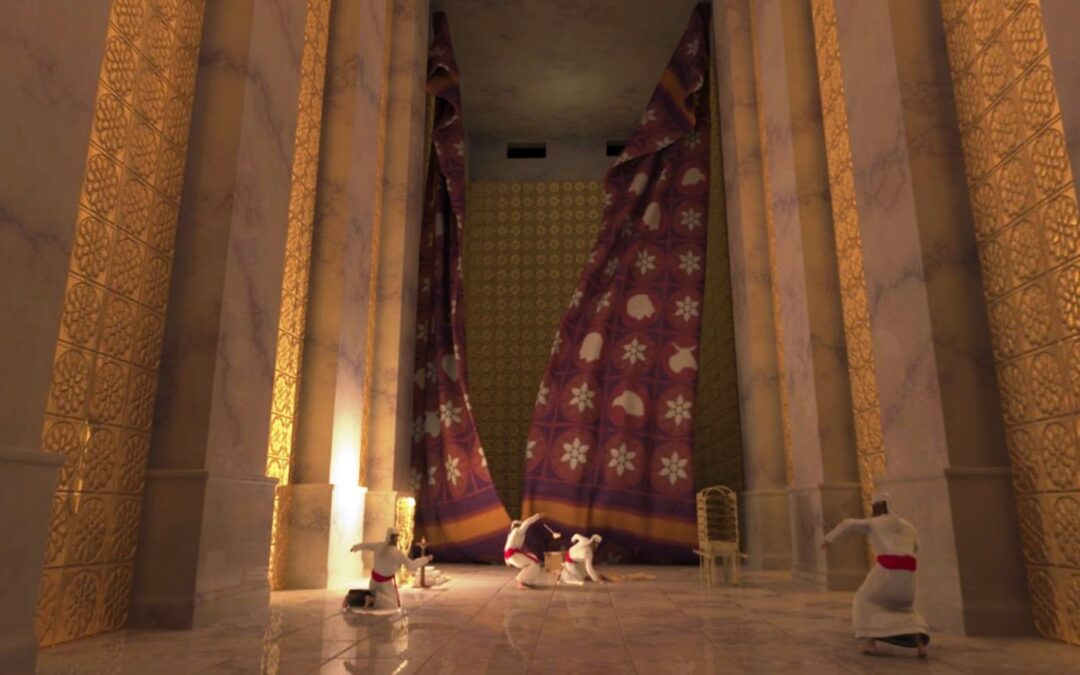
“And behold, the veil of the temple was rent in twain from the top to the bottom.”
(Matthew 27:51)
The sacrificial practices required by God from His people to atone for their sins prior to the death of Christ were originally established as the children of Israel traveled through the wilderness toward Canaan, led by Moses. God gave explicit instructions regarding the construction of the tabernacle, where all sacrifices were to be made, beginning in Exodus 25:8. Every aspect of the tabernacle, as well as its furnishings, typified Christ and God’s plan to atone for sin. This divine blueprint served as a shadow of the greater reality to come, pointing forward to the ultimate sacrifice that would reconcile humanity to God once and for all.
The wilderness tabernacle as well as the Jewish temple included three primary divisions—the courtyard, the Holy Place, and the Holy of Holies—and three veils covered the openings to each of these three divisions in order to separate sinful man from the presence of a holy God. The first veil opened into the outer courtyard surrounding the tabernacle proper. Those bringing their sacrifices could enter the courtyard through this gate. Only the priests could enter beyond the next veil covering the Holy Place. And only the high priest was allowed to enter beyond the final veil covering the Holy of Holies where God dwelt, and then only once a year on the Day of Atonement.
These barriers underscored the profound separation caused by sin and symbolized the inaccessibility of God under the old covenant, where rituals and representations maintained a necessary distance between God and man until Christ, the perfect High Priest, would arrive.
God accomplishes His will and plans with infinite precision and perfect timing. And it is possible that no other event in history reveals that to the degree that this miraculous event of Matthew 27:51 does—the tearing of the veil covering the Holy of Holies.
The Bible informs us that the darkening of the sky that occurred while Jesus hung on the cross started at the sixth hour (see Matthew 27:45; Mark 15:33; Luke 23:45). This is significant, for the sixth hour (noontime) was the very moment that the high priest Caiaphas, arrayed in his full priestly garments, began the procession in which he would enter the temple to slaughter a pure, spotless Passover lamb.
This darkness lasted until the ninth hour—the exact moment the high priest would be making his entrance into the Holy of Holies to offer the blood of the Passover lamb to cover the sins of the nation. It was at this moment that Jesus cried out, “It is finished!” (John 19:30). As He heaved upward to breathe for the last time, Jesus gathered enough air for a victory shout! His assignment was complete!
After proclaiming those words with His last ounce of strength, Matthew 27:50 tells us that He “…yielded up the ghost.” This precise timing highlights God’s sovereignty in that while the earthly high priest performed the annual ritual, the eternal High Priest was offering Himself once for all, rendering further sacrifices obsolete.
Matthew then writes, “And behold, the veil of the temple was rent in twain from the top to the bottom….” The word “behold” emphasizes something that is unexpected yet sure, or which seems impossible and yet occurs. This particular veil was sixty feet high, thirty feet wide, and an entire handbreadth in thickness! One early Jewish writing states that the veil was so heavy that it took three hundred priests to move or manipulate it. So it would have been impossible, humanly speaking, to tear such a veil.
At the exact moment Jesus was breathing His last breath on the Cross at Golgotha, Caiaphas the high priest was standing at his station in the inner court of the temple, preparing to offer the blood of a spotless Passover lamb. And at the very instant Caiaphas stepped up to kill the Passover sacrifice, Jesus exclaimed, “It is finished!”
At that same instant, miles away from Golgotha inside the temple at Jerusalem, an inexplicable, mystifying supernatural event occurred. The massive veil that stood before the Holy of Holies was suddenly split in half from the top all the way to the bottom! This was a divine proclamation that the barrier between God and man had been removed, and access to the Father’s presence was now granted through faith in Christ.
When Jesus was lifted up on the Cross, that Cross became the eternal mercy seat on which the blood of the final sacrifice was sprinkled.[1] Once that sacrifice was made, it was no longer necessary for a high priest to continually make sacrifices year after year, for Jesus’ blood had now settled the issue forever! For this cause, God ripped the veil of the temple in half, declaring that the way to the Holy of Holies was now available to everyone who would come to Him through the blood of Jesus! This is why the apostle Paul wrote that Jesus “…hath broken down the middle wall of partition between us” (Ephesians 2:14).
Contemplations:
- Unveiling the true holy of holies. O my blessed Lord and Savior, You who are that true holy of holies (Exodus 36), so long veiled, shadowed by types and figures. If I ever wonder, like John the Baptist who, while imprisoned, sent his disciples to ask the Lord, “are You he that should come?” (Matt. 11:3), help me remember the veil that was torn, fully affirming the confession of the Centurion, “truly this is the Son of God” (Matthew 15:39).
- Tearing the veil of my heart. O Lord, as You tore this veil of types to make way for my access to You, so tear that fleshly veil of idols from my heart to make way for Your grace to enter (2 Cor. 3:15-16). And while remembering Your last words on the cross, “It is finished,” help me embrace Your sufficiency alone, rejecting any efforts of my own in order to approach Your throne.
- Entering the holy presence boldly. In the rending of the veil, Lord, You have opened direct access to the Father, breaking down the wall of partition that once separated us. I reflect on how the high priest entered once a year with fear, yet now I can approach Your throne anytime through Your blood. This privilege stirs my soul to gratitude, reminding me that Your death fulfilled every shadow of the old covenant. Help me live in this reality, drawing near with confidence, confessing sins freely, and receiving grace abundantly. May this truth shape my prayers, making them intimate and fervent, as one welcomed into the Holy of Holies daily.
- Responding to creation’s witness. As the earth quaked and rocks split at Your death, Lord, creation was acknowledging the magnitude of Your sacrifice even while humanity often remains indifferent. I see in this a call to align my heart with the reverence nature displayed. Help me tremble at Your holiness and obey Your commands as the waves did. Help me recognize You as Creator and Redeemer, living in awe of the cross that shook the world and opened heaven’s way for me.
Prayer (Thanksgiving)
Eternal God, You reign supreme in holiness and power, the one who designed the universe with flawless intent and sustains it by Your word. Your glory outshines the sun, and Your righteousness stands unassailable against all sin. In both the tabernacle and the temple, You revealed glimpses of Your majesty through veils and shadows, pointing to the day when Your Son would tear them apart. I exalt You for Your perfect timing, aligning the high priest’s ritual with Christ’s final breath, demonstrating Your sovereign control over history and redemption. You alone could rend that massive veil from top to bottom, declaring access to Your presence for all who believe.
Before Your throne, I confess my failures to honor this opened way. Too often I have approached You casually, forgetting the cost of the torn veil and the blood that was sprinkled on the eternal mercy seat. My sins have erected barriers in my heart, veils of doubt and self-reliance that block full communion with You. I have relied on my own merits, patching the old garment of the law instead of trusting wholly in Christ’s finished work. Forgive my ingratitude, my presumption, and my neglect of this privilege. Cleanse me from these offenses, removing the hardness that hinders Your grace, and restore me through the blood that speaks better things than Abel’s.
I thank You profoundly for the miracle at Calvary, where the veil tore and shadows fled before the light of Your Son. Thank You for fulfilling every type and prophecy in Him, from the tabernacle’s design to the Passover lamb’s blood, all culminating in “It is finished.”
Your precision astounds me: as Caiaphas prepared the sacrifice, You provided the true Lamb, whose death abolished the need for annual offerings. Thank You that creation itself bore witness—the earth quaking, rocks breaking apart—affirming Christ’s lordship even as men rejected Him. This event freed me from separation from You, breaking down the middle wall and granting bold access to Your Holy of Holies.
I am grateful for the new covenant, where Your presence dwells not in a temple but in believers, through the Spirit. Thank You for chasing away the night shadows, as the Sun of righteousness rose with healing in His wings, opening the heavenly sanctuary forever. Your mercy in this act overwhelms me, securing my redemption and ending the curse of the law.
Lord, I beseech You to deepen my practice of this truth. Grant me daily grace to enter Your presence with reverence and joy, unhindered by doubt. Strengthen my faith to reject self-effort, resting fully in Christ’s all-sufficient merit.
And help me proclaim this gospel to others, that they too may experience the torn veil’s freedom. Protect me from distractions that veil Your glory anew, and fill me with Your Spirit to live as one redeemed. Finally, guide my steps in obedience, conforming me to Your Son’s image until I see You face to face.
In Jesus’ name I pray, Amen.
Further Scripture References for Matthew 27:51:
Rev. 11:19; Heb. 10:20; Luke 23:45; Mark 15:38.
[1] “But now I may, I must, I do mention the Atonement. I have sinned, but Christ has died.” John Newton understood that God is mercy-seated to the sinner through the crucifixion of Jesus Christ. His death is our substitute; his cross is our mercy seat; and the blood that he sprinkled there is our salvation. John Newton, entry for 18 September 1779, quoted in D. Bruce Hindmarsh, John Newton and the English Evangelical Tradition (Oxford: Oxford University Press, 1996), 232.
