
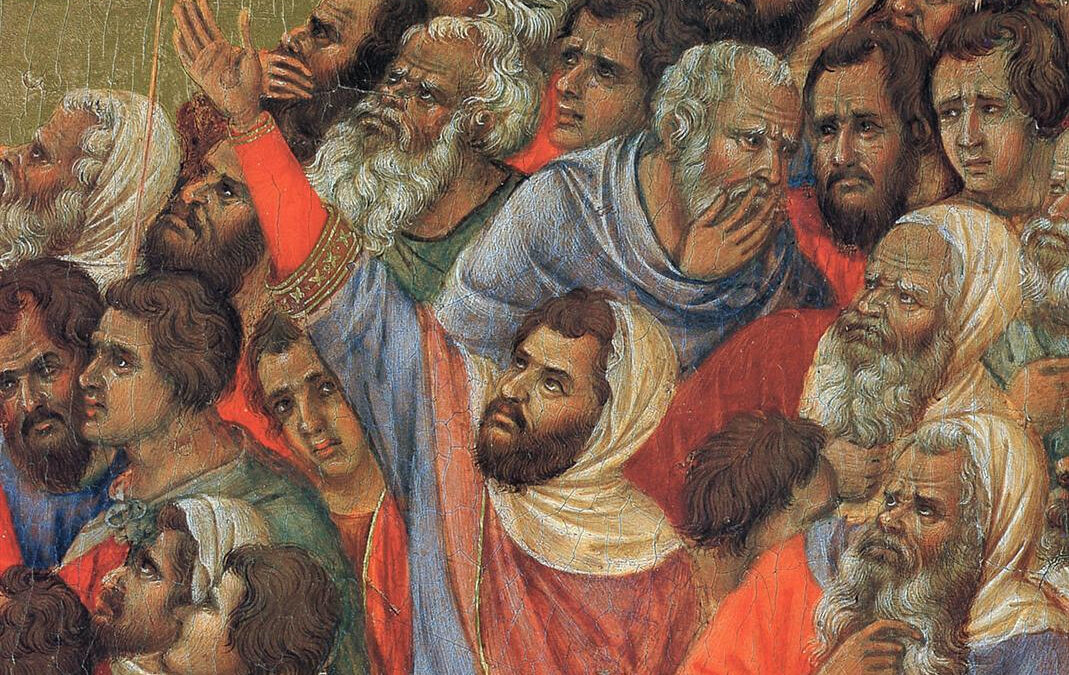
“And they that passed by reviled him, wagging their heads.”
(Matthew 27:39)
Pity is a natural reflex of fallen humanity. Even in sin, men often soften when they see suffering. The beggar, the wounded, the outcast all evoke compassion simply by the marks of their misery. But when Christ hung upon the tree, no such grace was extended. The Man of Sorrows, stricken and smitten, elicited not pity but mockery. “They that passed by reviled him, wagging their heads.” Not even the common criminal received such contempt.
The spectacle of the cross should have broken the heart of any with a conscience. Yet here was the Holy One, guiltless and pure, lifted up in agony, and still the crowd jeered. They saw Him bloodied, naked, and tormented. But instead of weeping, they snarled. Their mouths were full of taunts and eyes full of hatred. The prophecy in Psalm 22:7 unfolds with precision: “All they that see me laugh me to scorn: they shoot out the lip, they shake the head.” And again, “I became also a reproach unto them: when they looked upon me they shook their heads” (Ps. 109:25).
Why? Why did innocence provoke such contempt? Because His works had revealed His identity. He raised the dead, cleansed lepers, opened the eyes of the blind. But because He would not save Himself, they mocked Him. “Let him save himself, if he be Christ, the chosen of God.”
They could not see that He would not save Himself because He came to save others. The cross was not the defeat of His power but the display of His purpose. They mocked Him because He would not use His power for Himself. But therein lay His glory: mercy restrained omnipotence. He could have called down fire, but He chose the curse. He could have loosed the nails, but He chose obedience unto death.
But their cruelty did not interrupt redemption. In truth, it fulfilled it. Christ died under their scorn, so that no sinner could say, “My shame is too great to be pardoned.” For Christ bore not only pain, but mockery.[1] He bore the shame of sin, the weight of wrath, and the venom of the proud. And still He cried, “Father, forgive them.”
Contemplations:
- The Mockery He Endured for Me. My blessed Lord and Savior, what sort of difference is there between Your sufferings and those of others? Others draw at least pity and condolences while Yours elicit an onslaught of insults and contempt! “He saved others, but himself He cannot save” (Luke 23:35). The truth is that You chose to give up Your freedom from sin’s penalty of death so death could hold no power over me. You freed me from sin and from death by subjecting Yourself to Your own death.
- Omnipotence Nailed in Silence. How easily You could have come down from the cross, Lord! How easily You could have done to Your enemies what they bragged they did and could do to You. For though You remained nailed in misery to the cross, yet at Your word the seas, the winds, and the waves would still all obey You.
- Mercy is the Law of His Power. In my mind I will remember that Your will, Lord, is the rule of Your justice, and that Your actions do not always demonstrate the limits of Your power. For Your mercy is in and above all Your works (Ps. 36:5). Many times Your purposes may reserve, or suspend, or proportion the extent of Your action; yet nothing can confine Your power. Your word is not bound, so how much less Your power (2 Tim. 2:9)? For You are, in truth, the Son of God and equal with God.
Prayer (Confession)
O Lamb of God, I confess my guilt afresh before Your cross. You endured reviling, scorn, and wagging heads—not for Your sin, for You had none—but for mine. You bore the shame of sinners while I have so often been ashamed of You. You endured the taunts of wicked men while I have feared the whispers of a crowd. You hung in open contempt, while I shrink from open obedience.
Lord, I have passed by Your sufferings with cold eyes and hardened heart. I have treated lightly what demanded brokenness. I have looked without pity, as though the cross were merely a scene and not my sentence. Forgive me, O Christ, for every moment I have made peace with the world that mocked You. Forgive my silence, my cowardice, my ingratitude.
I confess, too, that I have often mocked You in my heart. When I disobey Your word, I wag my head. When I excuse my sin, I cast lots for Your garments. When I withhold mercy, I echo the crowd who said, “Save Yourself.” O Lord, forgive such wickedness in me.
Strip me of this pride. Let me see the Savior bleeding, reviled, and lifted up, and cry not in mockery but in mourning. May I never again pass by the cross without bowing the knee. You, O Lord, endured what I deserved. You bore the shame to remove mine. May my heart break where theirs scorned, and may my mouth confess You where theirs accused.
In Jesus’ holy name I pray, Amen.
Further Scripture References for Matthew 27:39
Psalm 109:25; Psalm 22:7; Lamentations 2:15; Mark 15:29.
[1] “He must bear poverty, need, and misery; He must know shame, mockery, and scoffing; He must suffer pain and death—He together with all who are His.” Martin Luther, Luther’s Works, Vol. 14: Selected Psalms III, ed. Jaroslav Jan Pelikan, Hilton C. Oswald, and Helmut T. Lehmann, vol. 14 (Saint Louis: Concordia Publishing House, 1999), 274–275.
