
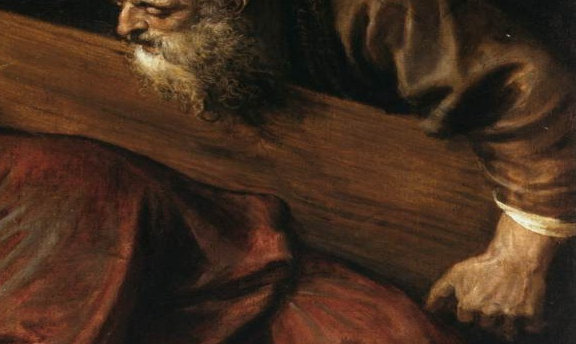
“And he bearing his cross went forth into a place called the place of a skull, which is called in the Hebrew Golgotha.”
(John 19:17)
There is no burden heavier than the cross, because it represents the sins of all the elect laid upon the back of the spotless Lamb. Jesus bore it bruised and bloodied, shredded by scourges, crushed beneath both divine justice and human rage. The world saw only a weary man collapsing under a wooden beam. But heaven saw the Redeemer staggering under the wrath of God.
With each step Christ took from Pilate’s judgment hall to Golgotha’s hill prophecy was fulfilled. With each wound He endured, righteousness was upheld. When His knees buckled beneath the weight, a Gentile was summoned to carry the cross. The symbolism here is astounding: rejected by the Jews, the blessing of the cross is borne by another.
The Jews refused the burden. But the Gentile, Simon of Cyrene, willingly received it and walked the remainder of the path alongside the Lord. Yet Simon’s part, weighty as it was, bore nothing of the curse. That lay solely on Christ. Only the Savior could suffer that guilt. Only He could satisfy the justice of the Father. Only He could drink the bitter cup to the dregs. Simon’s participation, however, shows what it means to follow after Him. The disciple does not redeem; but he must walk. He does not atone; but he must obey.
The cross is more than suffering, it is identity.[1] The Christian’s badge is not worldly comfort but sacrificial loyalty. “If any man will come after me,” Jesus says, “let him deny himself, and take up his cross, and follow me.” This is a command. There is no crown without a cross, no glory without Golgotha. The weight of the cross, then, is not just Christ’s to bear. It is also yours, if you would follow Him.
Contemplations:
- Christ’s Cross, My Salvation. O my blessed Savior, Your cross represented nothing but shame, torture, and death for You. And yet how abundantly it has yielded peace, triumph, and eternal joy for me. It is the ark that secures me from wrath, the rod that breaks my bondage, the ladder that lifts me heavenward. May I see in it both the horror You suffered as well as the hope it provides.
- Never Ashamed of the Cross. Lord, Your cross was stained with my guilt and bent beneath Your obedience. Let me not be ashamed of that tree, even when the world mocks it. Let me never hide my face from Your agony, for in that agony lies my redemption.
- A Disciple Must Carry His Own Cross. O Lord, I dare not wear the name of Christian unless I am willing to carrying Your cross. Grant me grace to walk behind You, not just in admiration, but in mortification. Let me not stop until my own Golgotha is reached, that there, too, You may bring me into Your glory.
Prayer (Confession)
Almighty God, I bow before the cross, confessing that it was not Roman hatred or Jewish scorn that nailed the Savior to that tree; it was my sin. My pride fastened the beams. My rebellion drove the nails. My unbelief pressed the thorns into His brow.
I confess that I have loved ease more than obedience, safety more than sacrifice. I have sought crowns without crosses, glory without grief, honor without humility. I have flinched at affliction and fled from suffering, though my Lord embraced both for my sake.
Forgive me for the ways I have turned aside from the narrow path. Forgive the fear that shuns Calvary. Forgive the sloth that leaves the cross untouched. Grant that I may count all things loss for the excellency of knowing Christ. Let me take up the yoke He bore and follow without complaint, even unto death.
O Lord, write the cross deep into my affections. Let me see in it not only judgment but mercy, not only sorrow but salvation. Make me willing to lose my life, that I may find it in Him who gave His for mine. And when I reach the last mile, may I find your footsteps leading even there. Amen.
Further Scripture References for John 19:17:
Luke 14:27, 23:33; Matthew 27:31, 33.
[1] “With this knowledge and sense we should, not be much terrified at the approaches of death in our last gasps, when we consider itself gasping under the weight of the cross. The blood of Christ is as a balsam dropped upon the points of the arrows of death. That, by removing the guilt of sin, pulled out the sting of death. When we tremble under a sense of our sins, the terrors of the judge and the curses of the law, let us look upon a crucified Christ, the remedy of all our miseries. His cross hath procured a crown, his passion hath expiated our transgression. His death hath disarmed the law, his blood hath washed a believer’s soul. This death is the destruction of our enemies, the spring of our happiness, the eternal testimony of divine love. We have good reason, as well as the apostle, to determine with ourselves, ‘to know nothing but Jesus Christ, and especially him crucified.’” Stephen Charnock, The Complete Works of Stephen Charnock, vol. 4 (Edinburgh; London; Dublin: James Nichol; James Nisbet and Co.; W. Robertson; G. Herbert, 1864–1866), 506.
