
“And he said unto them the third time, Why, what evil hath he done? I have found no cause of death in him: I will therefore chastise him, and let him go.”
(Luke 23:22)
How often are we backed into a position of choice between taking our stand alone with Christ or succumbing to the jeering crowd who are making a mockery of our God? At this mock trial of Christ before the mass of blood-thirsty Jews that had gathered, Pilate finds himself in a similar predicament. Occupying the judge’s seat, he must either condemn this Jew whom he believes to be innocent, or identify himself as an enemy of Caesar. That was precisely the choice put to him by the religious leaders who brought Jesus to Pilate, “He that maketh himself a king speaketh against Caesar … If thou let this man go, thou art not Caesar’s friend” (John 19:12).
Pilate would’ve happily spared Jesus, but because he feared his own fate with either choice, releasing Him was not an option. So he chose to spare himself instead. The religious leaders brought Christ to trial out of envy (Matthew 27:18), and Pilate delivered Him over to the executioners out of fear.
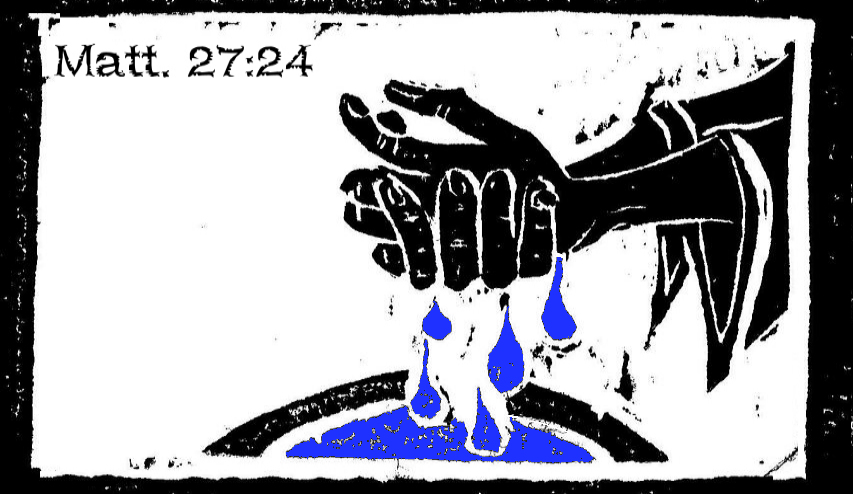
Pronouncing Christ’s innocence and publicly washing his hands of his blood guiltiness only serves to secure his own eternal condemnation. For innocence either absolves the prisoner or condemns the judge. To say, “Take ye him, and crucify him,” and yet, “I find no fault in him” (John 19:6; Luke 23:14) turns the point of Pilate’s sword into his own heart and makes the bench the bar.
With his wife’s dream and our Savior’s confession on the one side (Matthew 27:19), and the people’s willful violence and the threat of being identified as Caesar’s enemy on the other, Pilate’s soul was bound for destruction. How soon he discovered that his own conscience is a worse enemy than Caesar. Guilt at once kindled in his heart both shame and horror (Matthew 27:24), and it was so fierce a fire that the basin of water before him could not put it out. For what can a little water in a bowl or even Jordan’s floods do toward washing those stained hands that had the power to release innocence and yet chose not to (John 19:10)?
Pilate tries to shut his eyes so he cannot see his own heart, to make himself believe that he can wash away all the guilt of such an unjust sentence. The hypocrite in the end deceives not so much the world as himself, and at last God leaves him to think that he can deceive Him too. But neither water on the hands of Pilate nor the feet of Judas, though administered by the hands of our Savior Himself, can wash the guilt from a heart that is foul. The hand without the heart is nothing more than an altar without a sacrifice, or a sacrifice without fire (1 Kings 18:38).
For nothing can wash away the guilt of this blood but the merit of the same (Hebrews 9:22) without which all Pilate’s washing was in vain, regardless of how boldly he declares, “I am innocent of the blood of this just person: see ye to it” (Matthew 27:24). Solomon rightly says that God made man upright, but he has sought out many inventions (Ecclesiastes 7:29), not the least of which is how to hide the stains and shift the guilt of our sins. Even Adam, when called to account for his actions by God, shuffles the responsibility from himself to Eve, and then ultimately to God, “The woman whom thou gavest to be with me, she gave me of the tree, and I did eat” (Genesis 3:12).
Pilate would gladly be free from the blood of the innocent Christ, so not only does he wash his hands, but he says of himself, “I am innocent.”[1] But a basin of water from the local spring can do nothing to free us from the stain of sin. The only effectual cleansing for a heart racked by sin is the washing of water by the word (Ephesians 5:26). We must personally partake of the Water of Life if we desire to be thoroughly clean and truly free.
This experience of Pilate illustrates the futility of external rituals in the face of internal guilt. His public hand-washing, intended to absolve himself before the crowd, only amplified his complicity. The water he used symbolized a superficial attempt to cleanse what only divine mercy can purify. In contrast, the blood of Christ, shed shortly after, offers effectual and everlasting cleansing from sin’s defilement, as Revelation 1:5 declares He “washed us from our sins in his own blood.”
Contemplations
- Condemned by choice. Pilate believed You to be innocent, Lord, and still condemned You to death, fearing Caesar over justice (John 19:12). I confess similar compromises in my own life, choosing popularity or safety over truth. Forgive my cowardice and strengthen me to stand alone with You amid mocking crowds.
- Hand-washing hypocrisy. While publicly washing his hands, Pilate declared his innocence (Matthew 27:24), yet delivered You to death. How often do I do religious duties, like formal prayers, and yet without true repentance. Cleanse my heart, Lord, by Your blood.
- Shifting guilt. As Adam blamed Eve as well as You (Genesis 3:12), Pilate blamed the crowd: “see ye to it.” I find myself also evading responsibility, blaming others for my own sins. Help me take full responsibility before You for my sin, Lord, instead of trying to shift my guilt to another.
- True cleansing needed. Water failed Pilate because only the merit of Your shed blood can wash away guilt (Hebrews 9:22). Help me apply the water of Your Word to my heart for cleansing (Ephesians 5:26) and partake of the Water of Life freely.
Prayer (confession)
O righteous God, You are the judge of all hearts, exposing hypocrisy and demanding truth. I come before You, a sinner like Pilate, confessing my compromises that betray Your Son. Luke 23:22 shows Pilate declaring his innocence and yet chastising and releasing You to death. I grieve similar duplicity in my life.
I acknowledge fearing man over You, succumbing to crowds who are publicly mocking Your truth. Pilate feared Caesar (John 19:12), and I find myself yielding similarly to peer pressure. Forgive my cowardice that chooses self-preservation over standing with Christ.
Pilate washed his hands, declaring “I am innocent” (Matthew 27:24) while condemning the guiltless. Like Pilate’s basin of water that failed to wash away his guilt, my religious duties and efforts avail nothing without Your mercy. Cleanse me from superficial devotion and pierce my heart with true sorrow over my sin.
Break my chains of fear, envy, and hypocrisy, Lord. As Christ remained silent, bearing my guilt, let me own mine. I know there remains no condemnation for those who are Yours (Romans 8:1); and yet I often live condemned by compromise. Renew a right spirit within me, and cleanse me thoroughly.
In Jesus’ name I pray, Amen.
Further Scripture references for Luke 23:22
Luke 23:14, 16, Mark 15:15, John 19:12.
[1] “Will You wound the name of Christ, and pretend to be sorrowful for it? I conclude, thy pretense shall not excuse thee; for so was Pilate loth to crucify Christ; and as a means and expedient, he calls for water and washes his hands, saying, I am innocent from the blood of this just man: But do You think God excused Pilate? no more will he You: Whatever is brought to You, is either forbidden, or commanded by God: If forbidden by God, why do You meddle with it? If commanded of the Lord, why are You burdened with it? why do You it heavily? for the Lord loves one that is cheerful in his service: neither man nor God is pleased with such.” Edmund Calamy, An Exact Collection of Farewel Sermons (London: s.n, 1662), 386–387.
