
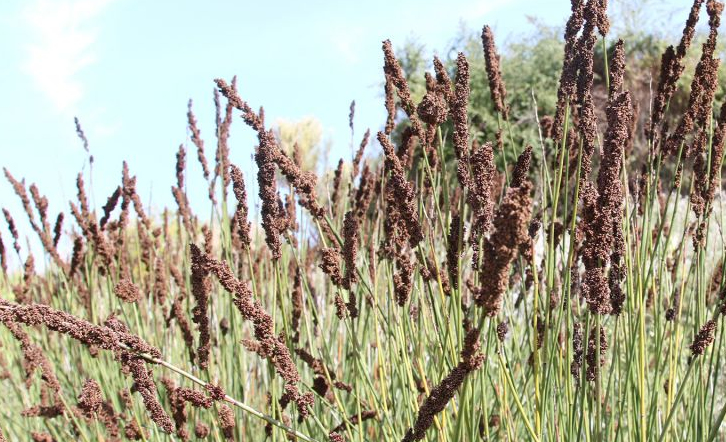
“And when they had platted a crown of thorns, they put it upon his head,
and a reed in his right hand: and they bowed the knee before him, and mocked him,
saying, Hail, King of the Jews!”
(Matthew 27:29)
The scene in this gospel narrative is one of blatant ridicule. Every gesture—the plaited crown, the scarlet robe, the kneeling—reeks of cruel satire. The scepter in Christ’s hand is a mock reed, frail and hollow, chosen precisely to represent their disdain. And yet, behind all their mockery lies a truth they cannot fathom.
It was that very hand which held the reed that raised the dead, healed the blind, and stilled the seas. That same hand formed Adam from the dust of the ground, carved the law into the stone tablets on Sinai, and upheld the stars of heaven. To place a reed in such a hand is to invite swift justice, but it does not come. Instead, He bears it silently. Why?
Because this was the plan from before the world began: to bear the shame, the mockery, the reed of derision, all for the sake of His people. The kingdom mocked by men is not one of outward pomp but of inward power. His authority is not seen in golden diadems or jeweled thrones, but in His meekness, endurance, and obedience unto death … even the death of the cross.
Isaiah compared Pharaoh’s broken promises to a staff of a dry reed (Isa. 36:6), which shatters under pressure. But Christ, though mocked with such a symbol, is no broken reed. Rather, He is the one who will not break the bruised reed, nor quench the smoking flax (Isa. 42:3). Even as they placed that hollow mock-scepter into His hand, He was holding fast to every broken soul who would one day call upon Him.
That reed, powerless in the hands of sinners, becomes in His pierced grip a sign of His restraint and mercy. He could have crushed Rome, split the earth, and called legions of angels. But He chose instead to conquer through suffering and to reign through selflessness.
Those who mocked with Him with the reed shall one day see Christ come again with a rod of iron, ruling the nations in righteousness (Ps. 2:9). His kingdom is unshakable (Heb. 12:28), established not by might but by truth.[1] But for now, the bruised reed rests in the hand of Him who understands its weakness and promises to uphold it.
Contemplations:
- A Scepter of Mercy. O my blessed Lord and Savior, You are the tree of life! How contradictory to Your nature it seems when Your hand is given a dry, dead reed as the sign of Your kingship. Yet You accepted it, not because it suited Your majesty, but because it suited Your mercy.
- Held, Not Broken. I must confess, Lord, I am that bruised reed bent under the weight of guilt, splintered by sin, and swayed by every storm of temptation. And yet, You do not cast me aside. Though justice could rightly strike, You instead strengthen what is weak and revive what is withering. You cursed the fruitless fig tree, but You nurture the bruised reed that clings to You in hope.
- Mocked Yet Mighty. The hand that held the reed is the same one that will one day hold the iron rod of judgment. You who can crush kingdoms withheld Your wrath for a time that mercy might be magnified. Teach me, Lord, to tremble at the gentleness of Your touch, and to find safety in the shadow of Your pierced hand.
Prayer (Confession)
Lord Jesus Christ, Son of the Most High, crowned with thorns, robed in mockery, and handed a hollow reed—how low You were brought for the sake of Your people. And yet, how low have I brought myself through sin and folly, mocking you by living as though Your rule were weak, Your law light, and Your grace unnecessary. I confess, Lord, that my own hands have not been clean. I have bowed not in reverence but in pretense and spoken Your name while doubting Your reign.
You held the reed in silence. Not because You lacked strength, but because You bore my shame. The bruised reed in Your hand speaks of me—feeble, often fruitless, wounded by guilt. Yet You did not cast me away. You bore my shame that I might share Your mercy. You accepted the empty scepter that I might receive the crown of righteousness.
Lord, forgive me for scorning Your meekness, for presuming on Your mercy, for trusting in the reeds of Egypt rather than in the power of Your Spirit. Teach me to rest in the strength of Your hand and to rejoice that Your kingdom comes not with fanfare, but with truth, grace, and glory. Amen.
Further Scripture References for Matthew 27:29:
John 19:3; Isaiah 53:3; Matthew 20:19; Luke 23:36.
[1] “…exegesis of the phrase “unshakable kingdom” (Hb. 12:28) notes that we are not to be content with what God gives us in the present but are to give Him the greatest thanks for what is to come.” 31 Chrys. Hom. in Hb. 33 (MPG, 63 [1862], 225) cf. also Theod. Mops. acc. to Staab, 211. Georg Bertram, “Σαλεύω, Σάλος,” in Theological Dictionary of the New Testament, ed. Gerhard Kittel, Geoffrey W. Bromiley, and Gerhard Friedrich (Grand Rapids, MI: Eerdmans, 1964–), 70.
