
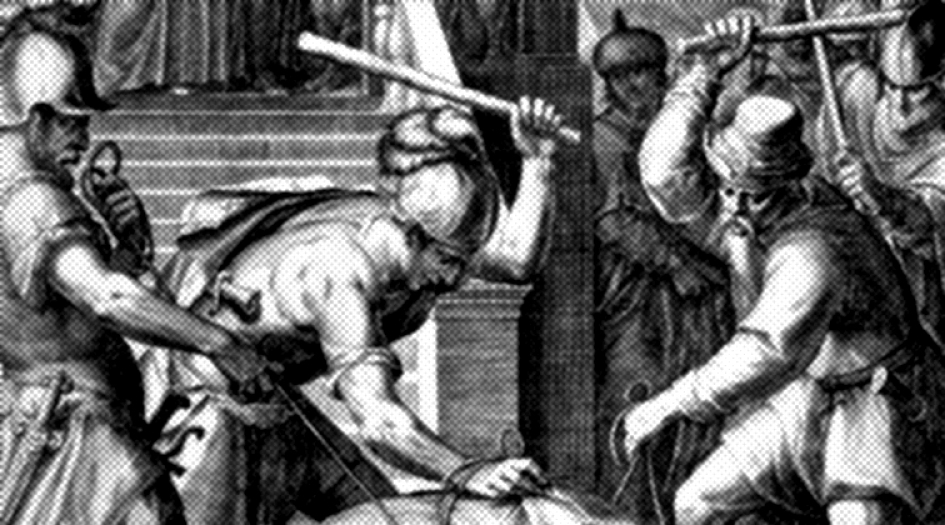
“And the men that held Jesus mocked him and smote him. And when they had blindfolded him, they struck him on the face, and asked him, saying, ‘Prophesy, who is it that smote thee?’”
(Luke 22:63-64)
The events that ensued between Christ’s arrest in Gethsemane and His crucifixion included all manner of unthinkable tortures of verbal ridicule and physical abuse. His accusers made sport with Him, turning persecution of the Savior into a game. They mocked Him, beat Him, blindfolded Him, and demanded He name the one who struck Him. They delighted not only in the violence, but in trying to extinguish the light that came into the world (John 1:9), as if their blindfold could veil the One in whom light and darkness are both alike (Ps. 139:12).
They reveled in their opportunity to strike the Light of the World, distorting the very face that shines salvation. Their behavior was the opposite the psalmist’s cry, “Turn us again, O God of hosts, and cause thy face to shine; and we shall be saved” (Ps. 80:7). Where saints lift their hands in the sanctuary to bless the Lord (Ps. 134:2), these murderers raised theirs to bruise the Son of God. Driven by envy and bitterness, those who were formerly enemies of each other united in their concerted malice to beat and batter the Prince of Peace.
Yet even in this, Scripture tells us that God’s plan was fulfilled. “Him, being delivered by the determinate counsel and foreknowledge of God, ye have taken, and by wicked hands have crucified and slain” (Acts 2:23). Their hands carried out the wickedness that was in their hearts. But the will driving such evil acts was divine. “Jesus Christ came in such a low condition, to leave an occasion (not a cause) in the hand of Satan, easily to prevail with the wicked Jews and Pagan Romans, to be so bold as to put to death that innocent person Jesus Christ; for the accomplishing of God’s Counsel (Acts 2:23).”[1]
Every blow, every stripe, every mocking taunt was part of the ransom agreed upon by the “determinate counsel and foreknowledge of God” before the foundations of the world were laid. As Isaiah prophesied, the Messiah would give “his back to the smiters” and not hide “his face from shame and spitting” (Isa. 50:6), Peter confirmed that “by His stripes we are healed” (1 Peter 2:24).
His slaughter satisfied the atonement required for our sins. The holy, harmless, undefiled Lamb of God was led through a gauntlet of scorn and wrath to the slaughter, and not as a helpless victim—but as a willing sacrifice. He bore it for His own. He bore it for me. There was no other way to redeem a rebel like me. No clean path, no ceremonial shortcut. The full weight of wrath had to fall. And it did. He did this for me.
Contemplations:
- Unworthy and sought. I am so low, Lord, by nature, that I must with the prophet claim kinship with corruption (Job 25:6). I was dead in my trespasses and sins; my heart was leavened with spite and malice. And yet how mercifully You sought for me in this low and dejected state.
- Mockery in hypocrisy. But, alas Lord, how often have I myself mocked You in hypocrisy when I bow my knees before You but not my heart. Have I given You the empty title of my King, and yet not paid You due tribute?
- Service without scorn. Though my sins wound You, Lord, do not let my service mock You as well. Let my labor for You be true, from my heart. Let my allegiance to Your kingdom be rooted in truth and love and not in show; not in the form but the power of godliness. You who so freely gave Your “back to the smiters” (Isa. 50:6) will not surely deny it to my burdens. Because You did not hide Your face from shame and spitting in this time of Your trouble for me, I may confidently say with David that You will not hide Your face from me in the time of my trouble.
- Light of Your countenance. You gave Your cheeks to those who plucked Your beard from Your face for me, so surely You will not withdraw them when, with David, I shall in faithful reverence, “kiss the Son lest he be angry.” You who set Your face as a flint to endure all these scornful scoffs and blows, how should You not show forth the light of that countenance to me, now, as I seek Your face.
Prayer (Thanksgiving)
Lord Jesus, I thank You with trembling awe that You stood still when they struck You. You didn’t pull away when they blindfolded Your eyes. You didn’t flinch when fists landed on Your face. You took it all. You let the scorners mock You. You let wicked hands defile Your glory. And You did it for me.
I deserved the whip. I deserved the jeers. But You, the spotless One, stood in my place. You let shame run its course. You bore the beating I had earned. And You did not open Your mouth to defend Yourself. That silence thunders through my soul. That patience humbles every excuse I’ve ever made.
I thank You for enduring that night of cruelty, for setting Your face to obey the Father’s will even when men spat in it. I thank You that You did not lash back. That You let them blindfold the very eyes that see all. That You let Yourself be questioned by fools who knew nothing of Your glory. Thank You for holding still, for holding fast, for not calling the legion of angels that could have swept them all away. You stayed. You bore it. You fulfilled the plan for me.
Thank You for every stripe, every bruise, every taunt, every drop of blood. Thank You that none of it was wasted. That every moment of suffering had my name tied to it. You were wounded so I could be healed. Bruised so I could be comforted. Scorned so I could be received. You were mocked so that I would not be condemned. You were blindfolded, so I could see. You were struck down, and by it I stand. That’s why I thank You, and not with words only but with a heart bowed low.
You did not refuse to suffer, rather You embraced it. You walked into it with full knowledge, full willingness, and full obedience. Thank You for such mercy, Lord. Keep Your sacrifice ever fresh before my eyes. Let me never treat it lightly. Let me never forget what it cost both You and the Father. And let me never stop saying with my heart full of gratitude: He did this for me.
In Jesus’ name I pray, Amen.
Further Scripture References for Luke 22:63-64:
Isa. 50:6; Micah 5:1; John 8:59; Matthew 26:4.
[1] Urian Oakes, John Eliot, Thomas Thacher, James Allen, et al., The Harmony of the Gospels, in the Holy History of the Humiliation and Sufferings of Jesus Christ, from His Incarnation to His Death and Burial, (Boston; John Foster, 1678), 42.
