
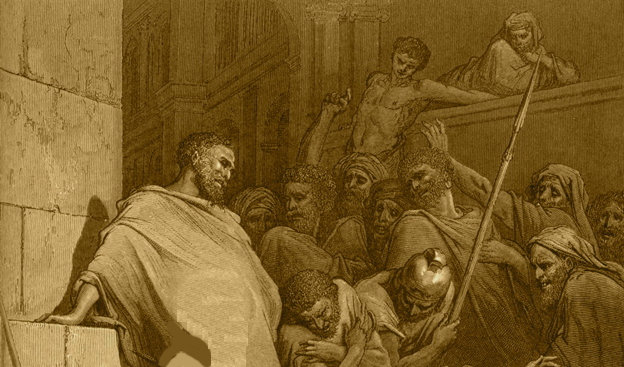
“And the men that held Jesus mocked him and smote him. And when they had blindfolded him, they struck him on the face, and asked him, saying, ‘Prophesy, who is it that smote thee?’”
(Luke 22:63-64)
The presence of the shepherd provides a feeling of safety and security for the sheep; without him they scatter. That’s what happened with the apostles when Christ was arrested in Gethsemane. Once the Great Shepherd was taken, His followers fled in fear and confusion (Zech. 13:7).
In accordance with God’s grand plan, the same Christ who made the heavens, commands angels, and shakes devils with a word is now held in the grip of wicked men. He who once said, “Let there be light,” is blindfolded, struck, and mocked by dust-born rebels who dared lift their hands against the Holy One.
But what was there to mock? His words were few and always full of grace. Even his enemies once stood amazed, saying, “Never man spake like this man” (John 7:46). His conduct was flawless. His demeanor, always measured and holy. His face which was fairer than the sons of men, bore no guilt. Every part of Him called for reverence. Yet they treated Him as a fool to mock and a target to spurn.
Israel once demanded a king so they could be like other nations (1 Sam. 8:5, 19-20), so God gave them kings. But more than that, in the fullness of time He sent them the King of kings. And what did they do with Him? They crucified Him under the very title they gave Him—”King of the Jews” (John 19:19). He who once amazed them in the temple at age twelve, who healed the sick, raised the dead, fed thousands, calmed storms, cast out devils … this same King they despised, rejected, spit on, beat, and crucified.
The psalmist said kings have long arms and broad hands, symbols of power and generosity. But Christ’s hands bore more than that. They carried the burden of men’s scorn. Treason, envy, slander were all heaped upon His crown. Only the Son of God could carry such a weight without breaking.
And even still, He bids sinners come. “Come, buy and eat… without money and without price” (Isa. 55:1).[1] He was despised, that we might be accepted. Rejected, that we might be gathered. Struck down, that we might rise. The Good Shepherd laid down His life for the sheep, not under compulsion, but of His own will (John 10:11).
Contemplations:
- How long shall they mock? How long, oh Lord, shall the ungodly triumph? How long shall wickedness abound? How long shall they despitefully speak against Your people? Was it not enough, Lord, for You to leave Your throne and to embrace Your humanity (John 16), to become as a servant, lower than the angels (Heb. 2:9), in all things like us except in our sin (Heb. 2:17)?
- Sharing in Your burden. You did this all for me, Lord. You became a servant, both knowing and doing Your Father’s will. It was Your very meat and drink to do so (John 4:34). Let me share in Your strength that I might take up Your cross and follow You in all things.
- Shame for my sake. It was God’s way that You, Lord, become not only a man, but a servant of men, bearing the scorn of men (Phil. 2:7). For how could Your blood satisfy our debt to God without Your shame? Could You have the wounds without their scoffs? Alas no. You did this all to save me from eternal damnation and reward me with life in heaven with You.
Prayer (Confession)
Lord, I confess that I, too, have rejected You with silence, with compromise, and with a heart too cold when it should burn. You stood before Your accusers blameless, innocent, radiant with the beauty of holiness, and they mocked You. And though I claim Your name, how often I have treated You with similar contempt.
I have called You Lord with my lips while chasing other masters with my life. I have worn Your name while hiding from Your cross. I have stood by, mute, when Your honor was trampled, fearing man more than God. I have watched You blindfolded and beaten in the scorn of this world, rather than stand beside You, I have stepped back, stayed quiet, and made peace with what I should hate.
Forgive me for mocking You with half-hearted prayers, for wounding You again with sins I excuse, for rejecting You in the secrecy of my thoughts while outwardly bearing Your name. I have sinned, Lord. And my sin is no light thing. It was my pride that helped shape the thorns. My rebellion carved the rod. My coldness mocked Your grace.
Have mercy on me, O Christ. You bore rejection so that I might be accepted. You were blindfolded so I could see. You were struck that I might be healed. Wash me from this guilt. Take away the deceit in my heart. Cleanse the hidden faults. Break the hardness that resists conviction. Let me mourn what I once excused.
Let me never again be numbered among those who reject You. Let me follow where You lead, stand where You stood, bear what You bore … not to atone, but to obey. Let my life no longer carry the echo of mockers but the witness of the redeemed. You were despised for me. I cannot be indifferent. You were rejected that I might be accepted. I cannot remain silent.
Break my pride. Crush my self-will. Lead me to repentance that runs deep. And if I am struck in following You, let it be counted an honor. Let my shame be a mark of loyalty. I will not be ashamed of You, Lord. Not anymore.
In Jesus’ name I pray, Amen.
Further Scripture References for Luke 22:63-64:
John 18:22; Matt. 26:59; Mark 14:55, 65; Heb. 12:2.
[1] “Meditate with Yourself how You are invited by Christ to be a guest at his Holy Table, and how lovingly he invites You.” Lewis Bayly, The Practice of Piety Directing a Christian How to Walk, That He May Please God / Amplified by the Author, Early English Books Online (London: Printed for Edward Brewster, 1695), 339–340.
