
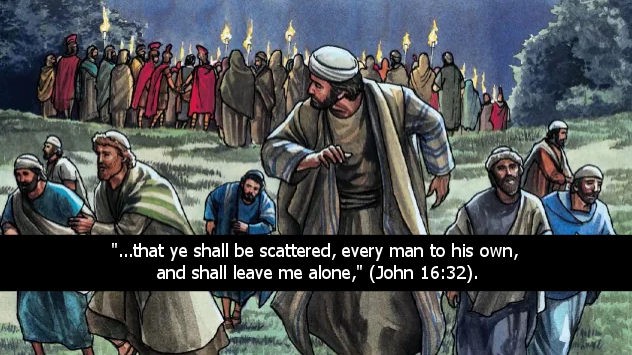
“Behold, the hour cometh, yea, is now come, that ye shall be scattered, every man to his own, and shall leave me alone: and yet I am not alone, because the Father is with me.” (John 16:32)
True friends multiply joy and lessen sorrow, for they “stick closer than a brother” (Prov. 18:24). Christ’s most faithful earthly friends were His apostles, specially chosen by Him. But when He needed them most, they were gone. As Isaiah reports, “I have trodden the winepress alone; and of the people there was none with me” (Isa. 63:3). In Psalm 69:21, the cry is the same: “I looked for some to take pity, but there was none; and for comforters, but I found none.” In His greatest trial, Christ’s dearest friends deserted Him.
He came to his own, and they rejected Him. The Jews, His chosen people, accused Him of gluttony, drunkenness, blasphemy, and even called him Beelzebub (Matt. 11:19). In Galilee, He was treated with scorn (Matt. 13:55; Mark 6:4). In Jerusalem, though amazed by His miracles and instructed by His sermons, the people broke His heart. “O Jerusalem, Jerusalem, how often would I have gathered you… but you would not” (Matt. 23:37). And when He was arrested, they accused Him of treason, sedition, temple profanation, and blasphemy.
Even among those who followed Him for a time, many did not remain (2 Tim. 4:10). John 6:66 records that “many drew back and walked no more with him.” And His inner circle? Those who once declared, “To whom shall we go? You have the words of eternal life,” fled when the hour darkened. One betrayed Him. One denied Him. And all abandoned Him.
What does it mean that even His closest forsook Him?[1] If the light goes dim, how great is that darkness? If the salt loses savor, what can restore it? (Matt. 5:13). If these mighty cedars become shaking reeds, then none of us stand on our own. These men, entrusted with the mysteries of the kingdom (Luke 8:10), crumbled under pressure. They pledged loyalty, yet fled when it cost them most.
David could stand against ten thousand because the Lord upheld him (Ps. 3:6). But the moment God’s sustaining grace was pulled back, David trembled (Ps. 55). The man after God’s own heart had no strength of his own. God shows us our own frailty by letting us fall, to remind us whose hand truly holds us (Ps. 9:20). Without Him, we are nothing.
Contemplations:
- The lonely burden of Christ. O my blessed Lord and Savior, You call all to Yourself and say, “Come unto me, all that are heavily laden and I will give You rest” (Matt. 11:28). And yet must You, Lord, tread the winepress alone, bearing alone the whole burden of Your miseries (Isa. 63:3), such that not even one of Your apostles shares with You in one wound, stripe, or taunt?
- The cowardice of men. Blessed Lord, You did not need any of Your apostles to help You when it came to saving me from suffering. They ran from life itself, in order to save themselves. Let me never leave Your side, but rather help me ever do as they say, “Master, to whom else shall I go, for You have the words of eternal life.”
- The fall of the faithful. Lord, You allowed Your own apostles to fall that I might take better heed how I stand. Let me turn Your grace into watchfulness (Jude 1:4). If Your own parents lose You (Luke 2), Your own apostles desert You, how much more should I work out my salvation with fear and trembling (Phil. 2:12)? Let their fall serve to raise me from despair when I am down. But let me never take this as an excuse to fall, simply because I may rise again, but rather to stand in Your strength that I do not fall.
- The strength to endure. Lord, I know that without Your upholding grace I will fall. I see that if the apostles could fall, so could I—and worse. Let their story make me sober. And when I try to stand in my own strength, let me fall just far enough to remember it’s always been You upholding and sustaining me.
Prayer (Supplication)
O Lord my God, I ask for Your help because I know what I am without You. I’ve seen it in Scripture … those who walked with Christ, heard His voice, and touched His hands still fled when danger came. I’m certainly no better. If Your hand were taken away from me for a moment, I would collapse under the weight of fear, pride, or temptation.
You know I speak the truth. I don’t stand because of my faithfulness, I stand because of Your mercy. It is not my resolve but Your grace that keeps me from falling. And I’m asking that You don’t let me walk a single step alone. Uphold me with Your hand. Plant my feet firm when all around me gives way. When friends fail me, and my strength falters, stay with me.
Lord, help me see the dangers of overconfidence. Peter swore he would die with You, and hours later denied You to a servant girl. I don’t want to make promises I can’t keep. Help me to walk humbly. Make me wary of my own heart. When I start to rely on my gifts, shake me. When I grow proud in my knowledge, break me. I don’t ask for a painless path but for a faithful walk.
Give me the kind of spirit that clings to You when the crowd disappears. Teach me how to watch and pray when others sleep. Give me eyes that weep over sin, not just in the world, but in me. I need a heart that trembles at Your Word and finds rest in Your presence.
You know how quickly I forget, Lord. I forget the cross. I forget what it cost You. Remind me. Write it on my mind and drive it into my bones. Don’t let me betray You for comfort nor abandon You for safety.
And when I fall—and I know I will—don’t leave me there. Raise me up again. Not in my strength, but in Yours. Let me see the face of my Savior who was forsaken for me, who stood when all fled, who endured what I could never bear, and loved me still.
In Jesus’ name I pray, Amen.
Further Scripture References for John 16:32:
Matthew 26:31, 26:56; John 16:25; Zech. 13:7; cf. Acts 8:1.
[1] “True, he rebuked them for their unbelief, for the which also thou deservest the same. For it is unbelief that alone puts Christ and his benefits from us (John 16:32; Matt 28:9–11; Luke 24:39; Mark 16:14).” John Bunyan, Come and Welcome, to Jesus Christ, vol. 1 (Bellingham, WA: Logos Bible Software, 2006), 267.
