
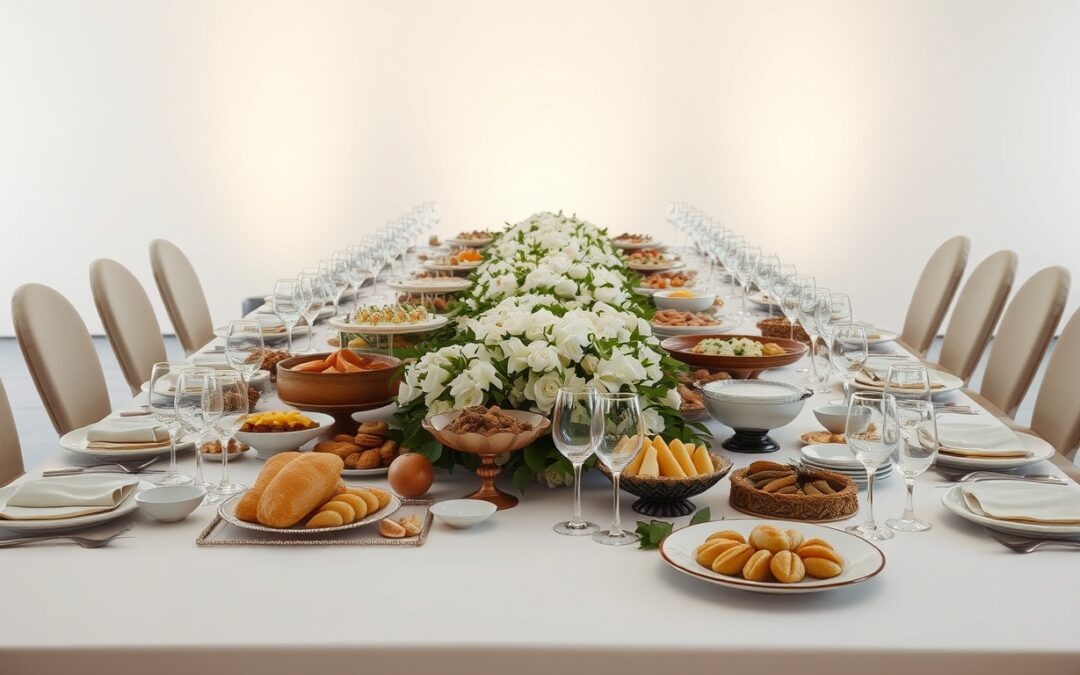
“Let us be glad and rejoice, and give honor to him: for the marriage of the Lamb is come, and his wife hath made herself ready.”
(Revelation 19:7)
Weddings are joyous by nature, and rightly so. But even the most beautiful wedding on earth, filled with love, laughter, and dancing, is only a shadow of what is to come for the Bride of Christ at the marriage supper of the Lamb.
Scripture often reminds us that life on earth is short. James describes it as “a vapor” because we’re here only briefly, and then we’re gone. And Job confesses that “Man that is born of a woman is of few days and full of trouble” (Job 14:1).
But along with the sorrow, grief, and afflictions that characterize this life, God gives joy even now. The cry of a newborn, the comfort of a friend, the grace of a quiet morning—these are small foretastes of something greater. And those united to Christ know that the joy awaiting them in eternity far outweighs all temporary pains. For when Christ, our Bridegroom, returns, the joy that will flood the souls of the redeemed at the sight of their King will be beyond measure.
The prophets and apostles describe the scene with language stretched to its limit:
“For ye shall go out with joy and be led forth with peace: the mountains and the hills shall break forth before you into singing” (Isa. 55:12). “In this mountain shall the Lord of hosts make unto all people a feast of fat things” (Isa. 25:6). And “Blessed are they which are called unto the marriage supper of the Lamb” (Rev. 19:9).
Samuel Hopkins observed, “This great increase of happiness and joy will be the natural, and even necessary, consequence of the great degree and universality of knowledge and holiness, which all God’s people will then possess.”[1] Such joy will overflow from seeing Christ, knowing Him more fully, and adoring Him without sin or distraction.
Moreover, the saints in heaven will never tire of glorifying God. Their joy will increase with every moment spent in His presence. Knowledge will deepen, holiness will be complete, and love will burn without hindrance. That is the eternal reward of those who are clothed in Christ’s righteousness.
But this feast is not for all. Only those covered in His perfect garment, the righteousness of the Lamb, will enter. Without His blood applied, no soul may dine at that table. There must be union with the Bridegroom. There must be holiness. There must be true saving faith. Otherwise, there is no seat at the feast.
So now the bride prepares. She readies herself by faith, clothed in purity not her own. She does not focus on the trials around her but rather on the promise ahead. For the Lamb has come … and His bride has made herself ready.
Contemplations:
- Joy beyond comparison. I’ve experienced good days, even great days, but they’re nothing compared to what awaits. Every joy here fades too fast. But the joy of seeing Christ will never fade, never grow old. I long for the day when every part of me will rejoice without interruption. Until then, I must remember that no sorrow now can overshadow the glory that is to come.
- Heaven is certain. I don’t deserve a place at the marriage feast, but Christ has secured it for me. He’s made me part of His bride and clothed me in righteousness. That reality should shape how I live right now, reminding me to look ahead with more certainty than I do. For heaven is not wishful thinking, it’s a blood-bought promise.
- The bride must be ready. I want to be found ready and not waste my days distracted by things that won’t last. Christ is coming, and the bride must not slumber. I want to live more holy, keeping watch until the day He returns.
- A feast with the King. There will be no sorrow at that table. No pain, no shame, no sin. Just joy. Pure, full, overflowing joy in the presence of Jesus. That thought humbles me. It stirs something deep in me… a thankfulness I can’t put into words. He didn’t have to invite me. But He did. And He will seat me with the saints in glory.
Prayer (Thanksgiving):
Lord Jesus, You are the Bridegroom who calls His people to the feast. You’ve prepared the table, You’ve clothed the bride, and You’ve promised joy beyond anything my heart can contain. I thank You. Thank You for calling me out of darkness and setting my name among the redeemed. Thank You for clothing me in Your own righteousness so that I might be made ready for that glorious day.
Thank You that You do not leave me to prepare myself. You have washed me, covered me, sanctified me by Your Spirit. I don’t belong at the table by merit, but by mercy. And for that mercy, I give You praise. For the blood that secured my place, I give thanks. For the hope that outlasts grief, I bless Your name.
When I look around this broken world, full of sorrow and pain, I’m grateful You’ve set my eyes on a better country. You’ve reminded me through Your Word that joy is not chained to this present moment; it is anchored in eternity. Thank You that my hope is not fragile. It rests in Your finished work and Your unshakable promises.
Thank You that when You return, I will not be cast out. You’ve already spoken peace to my soul. You’ve already declared me Yours. The day is coming when I will see You face to face, and in that moment, every tear will be wiped away. Every burden will fall off. Every fear will vanish. And I will sit at the feast as one You have loved from before the foundation of the world.
Thank You for that coming joy. Thank You for the daily mercies that point me forward to it. Thank You for the Spirit who keeps me, the Word that feeds me, and the grace that restores me when I stumble. You are preparing me even now, and for that work, I am grateful.
May I never take for granted that I am part of the bride. May I not lose sight of what lies ahead. Stir my soul to worship even now. Let joy break in early. Let thanksgiving rise, not just for what is to come, but for what You’ve already done to make it certain.
In Jesus’ name I pray, Amen.
Further Scripture References for Revelation 19:7:
Rev. 21:2, Hosea 2:19, Luke 12:36, Eph. 5:32, 2 Cor. 11:2.
[1] Samuel Hopkins, A Treatise on the Millennium. Showing from Scripture Prophecy, That It Is yet to Come, Early American Imprints, 1639-1800; No. 25635 (Boston: Isaiah Thomas and Ebenezer T. Andrews, proprietors of the work, Faust’s Statue, no. 45, Newbury Street, 1793), 66.
