
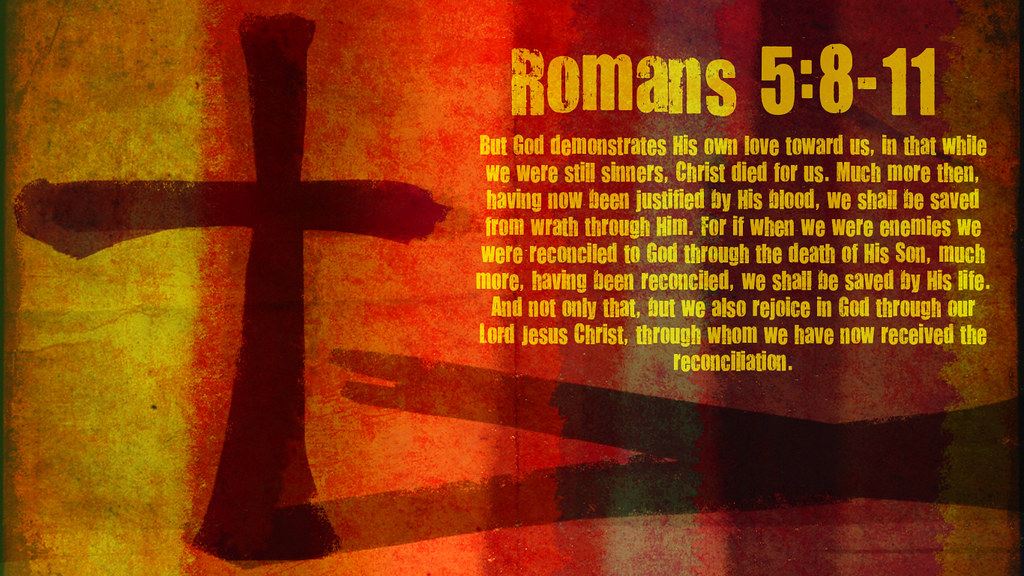
“…but God commendeth his love toward us, in that,
while we were yet sinners, Christ died for us.”
(Romans 5:8)
The love of God, unlike the fickle sentiments of humanity, is divine action rooted in eternity, displayed at the cross, and applied to wretched sinners… and this passage in Romans 5 encapsulates the infinite weight of such love. It declares that God, moved by His own love for fallen man, sent Christ to die for us while we were still sinners. Not after our reformation, not upon repentance, not once we had sought Him. But when we were yet dead in sin, rebellious, defiled, and worthy of wrath.
Earlier in his letter to the Romans, Paul highlights our condition with disturbing clarity: “There is none righteous, no, not one… all have sinned” (Romans 3:10, 23). The human soul is bankrupt of righteousness, unable to move even one step toward God. We are described as ungodly (v.6), enemies (v.10), without strength.
“But God…”
It is on these two words that eternity turns. These two words bear the full weight of the Gospel—that judgment is deserved, yet grace is bestowed. The contrast between death and life, wrath and peace, condemnation and justification is revealed in these two words.
For God did not merely overlook our sin. He didn’t extend a hand from a distance. He came down. He gave His Son. He laid our sin on Him, and then poured out holy justice on His only begotten Son so that His unfathomable love might be lavished on the guilty.
“He then confirms, that is, exhibits his love to us as most certain and complete, inasmuch as for the sake of the ungodly he spared not Christ his own Son. In this, indeed, his love appears, that being not moved by love on our part, he of his own good will first loved us, as John tells us.”[1]
Paul uses the word “commendeth”—meaning God sets forth, proves, and demonstrates His rich, eternal, resolute love in the most glorious and indisputable way. He has shown us His love not in prosperity, not in earthly gifts, but in the bloody cross of Christ. His cross silences every doubt, dismantles every prideful pretense, and brings low the self-righteous.
Every aspect of our salvation is rooted in this divine intervention. We were objects of wrath… “But God.” We were dead in sins… “But God.” We were on the path to hell, rightly condemned… “But God.” All the benefits of the covenant—regeneration, justification, sanctification, glorification—flow from the love of God in Christ, freely bestowed on us while we were still sinners.
These two words, “But God,” ought to ring in our ears daily for they are the banner over the Christian’s life, the heartbeat of grace… the Gospel in two words.
Contemplations:
- The power of divine interruption. There are many moments in my life that spiral in sin, in despair, or in foolishness, but then You step in. I cannot rescue myself; I cannot clean my soul. But You, Lord—You intervene, You break in, You stop me. You change my course when I cannot. “But God” becomes not just a truth of the Gospel but a lifeline for my daily walk. You are never late and never absent.
- A love shown, not merely spoken. So often I look for evidence of Your love in comfortable circumstances or answered prayers. But the cross is the proof. You showed Your love in the death of Christ, and that must always be enough for me. I must not require more signs when the greatest demonstration has already been given. I was loved while I was Your enemy. What more could I possibly ask for?
- Mercy rooted in eternity. This love You have for me did not arise in a moment of pity or in response to my efforts. It is a love from before the foundation of the world. It humbles me that nothing in me prompted it. It was Your good pleasure alone. This anchors my assurance, because if You loved me when I was in sin, how much more, now that I am reconciled, will You keep me?
- Joy in the simplest phrase. “But God”—two small words that contain endless joy. I repeat them when I am discouraged. I preach them to myself when tempted. I cling to them in sorrow and trial. They are words of infinite import, words that lift burdens, words that push back despair. I love them, because they show me You are not finished with me.
Prayer (Adoration):
O God, eternal and blessed, how rich is the mercy that flows from Your throne. I worship You not for what my eyes can see or what my hands can hold, but for what You have revealed in Your Word—the invincible love You have for sinners. There is none like You, whose compassions are not stirred by beauty in us, but by goodness in Yourself. While I was a rebel, You gave Christ. While I was a child of wrath, You made me a son by grace. You do not love as men do. Your love is not reactionary, not shifting, not moved by sentiment. It is sovereign, holy, and full.
I adore You for loving the unlovely. I praise You that my sin did not turn You away, but drew forth the crimson flood of Your mercy. Christ died for me when I was wicked. This Gospel truth breaks my pride and feeds my soul. I lift my heart in awe of You, the God who justifies the ungodly, the God who raises the dead, the God who gives righteousness to the spiritually bankrupt.
Your grace does not depend on my consistency, my discipline, or my obedience. It rests solely in Your eternal decree and the finished work of Jesus. This steadies me when my heart condemns me, for You are greater than my heart. You do not lie. You have bound up all my hope in Your covenant faithfulness.
Let the cross be ever before me, Lord. Let me never forget that You showed Your love in suffering and blood. Let my life be shaped by this mercy, this kindness, this undeserved favor. Let all my worship rise from this well—that You loved me when I hated You, that You gave Christ when I was still a rebel, that You made peace through His blood.
You are the fountain of love, the source of grace, the everlasting joy of the redeemed. I lift my voice in thanksgiving. I raise my hands in praise. I bow my heart in awe. For You are my God—and I am Yours.
In Jesus’ name I pray, Amen.
Further Scripture References for Romans 5:8:
John 3:16, 1 John 4:9, John 15:13, Rom. 5:6, 1 Peter 3:18, 1 John 4:10.
[1] John Calvin, Commentary on the Epistle of Paul the Apostle to the Romans (Bellingham, WA: Logos Bible Software, 2010), 196.
