
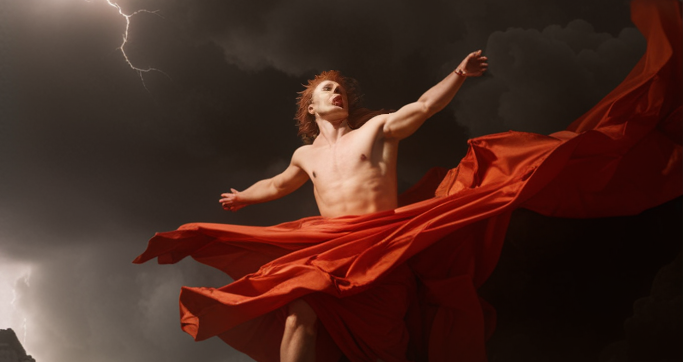
“God spared not the angels that sinned, but cast them down to hell, and delivered them into chains of darkness, to be reserved unto judgment.”
(2 Peter 2:4)
God created a multitude of celestial beings, known as angels or “messengers” in Scripture, to serve His purposes and glorify His name (Ps. 103:20). Declared “good” at their creation, these beings were designed to worship and obey the Almighty with perfect submission.
Among them was Lucifer, the “light bearer” or “morning star,” a prominent angel adorned with splendor. Yet, as Ezekiel 28:15-17 reveals, “iniquity was found in him,” born of pride in his own beauty and power. This pride fueled his rebellion, as Isaiah 14:12-15 tells us, when he sought to ascend above God, desiring the worship due only to the Creator. His ambition led to his fall, and with him, a host of angels who joined his revolt were cast out of heaven (Rev. 12:7-9). And as a result, the final destiny of Satan, the “adversary,” and his demonic followers was cast; they are all destined for the lake of fire, an eternal judgment without hope of redemption (Matt. 25:41; Rev. 20:10).
William Perkins captured the gravity of their fate, stating, “They do this in their wickedness, and will exercise it as much as they can, knowingly being reserved for judgment for their sin” (1 Pet. 5:8; Eph. 6:12; John 8:44).[1] The fallen angels’ rebellion stands as a stark warning of the consequences of defying God’s authority. Their sin of deliberately rejecting their Creator resulted in their immediate expulsion from God’s presence and eternal condemnation. Unlike humanity, they were not offered a path to restoration, for their chains of darkness symbolize the irrevocability of their judgment. This action affirms that God’s holiness cannot tolerate rebellion and that His sovereignty upholds His righteous decrees.
In contrast, God’s mercy toward fallen humanity is astounding. Despite our inherited sin from Adam’s disobedience, God provided redemption through Jesus Christ (John 3:16). This distinction is profound: while angels who sinned face eternal separation, humanity is offered reconciliation through Christ’s sacrifice. The Son of God took on human flesh, lived a sinless life, and died a substitutionary death to satisfy divine justice, securing eternal life for those who believe. As Romans 3:24 declares, we are “justified freely by His grace,” a gift not extended to the fallen angels.
The angels’ fall illustrates the severity of sin, while humanity’s redemption showcases the extravagance of grace. We are not left to the fate of demons, bound for destruction, but invited into a covenant relationship with our Creator.
This truth calls us to cling to Christ, who alone can bridge the chasm between our sinfulness and God’s holiness. It also moves us to gratitude, recognizing that our salvation is a privilege denied the fallen angels and secured only through the blood of the Lamb.
Contemplations:
- Fearing to offend You. O my Soul, do not be high minded; do not presume to sin against God. Rather fear to offend Him. The angels’ fall warns me to guard my heart against pride and rebellion, trusting in Your mercy alone.
- Christ’s glorious judgment. At the day of judgment, Christ will descend from heaven in visible pomp and splendor inexpressible, clothed with His own glory as well as that of His Father’s, and attended with all the shining entourage of heaven. He will seat himself on a glorious white throne in the lower heavens and having summoned before Him the whole creation of angels, men, and devils, will judge and sentence them according to their respective characters and works. This truth humbles me to live for Your glory.
- Trembling at Your justice. God has the power to leave sinners in that miserable estate to which they have plunged themselves. And justly He may do so, for in this same way He has dealt with the angels that sinned. The angels which did not keep their first estate but left their own habitation He has reserved in everlasting chains under darkness to the judgment of the great day. This truth should cause us all to tremble.
- Sin’s consequences. Judgments are consequents of sin. Concerning the judgments recorded in Scripture, sin is always the cause behind all curses. The first judgment ever inflicted on a creature was the casting down of angels into hell. But these are expressly said to be angels that sinned. The next was on the serpent, “the great dragon” to whom the Lord said, “Because You have done this You are cursed.” Help me flee sin and cling to Your grace.
Prayer (Supplication)
O righteous and merciful God, You are the sovereign Creator whose justice condemns rebellion and whose grace redeems the fallen. Your distinction between the fate of angels and humanity, as 2 Peter 2:4 declares, reveals Your holy wrath and boundless love. I worship You for Your unyielding justice that sentenced fallen angels to chains of darkness, and for Your mercy that offered salvation through Christ’s blood. Your Son’s supremacy over all powers secures my hope where angels found none.
I confess that I have often presumed upon Your grace, harboring pride and flirting with sin as if it held no consequence. Like the angels, I have been tempted to seek my own glory, ignoring the warning of their fall. My heart has not always trembled at Your justice, nor have I lived fully in gratitude for Your redemption. Forgive me for these sins, for failing to honor the distinction of Your mercy. Cleanse me through Jesus’ blood and renew my heart to fear and love You.
Lord, I plead for grace to walk humbly before You. Guard me from high-mindedness, as the angels’ rebellion warns, and fill me with Your Spirit so that I may resist temptation and reflect Your holiness. And conform me to Christ’s image, that I may honor You with a life of faith and obedience.
In Jesus’ name I pray, Amen.
Further References for 2 Peter 2:4:
Jude 1:6; Matt. 25:41; Rev. 20:10; Matthew 8:29.
[1] William Perkins, An Abridgement of the Whole Body of Divinity (London: W.B., 1654), 24.
